Claude Ship Explained: What It Does, Who Can Use It, and What to Check First
Three agents for GitHub pull requests, for Team and Enterprise plans, with some parts still in beta
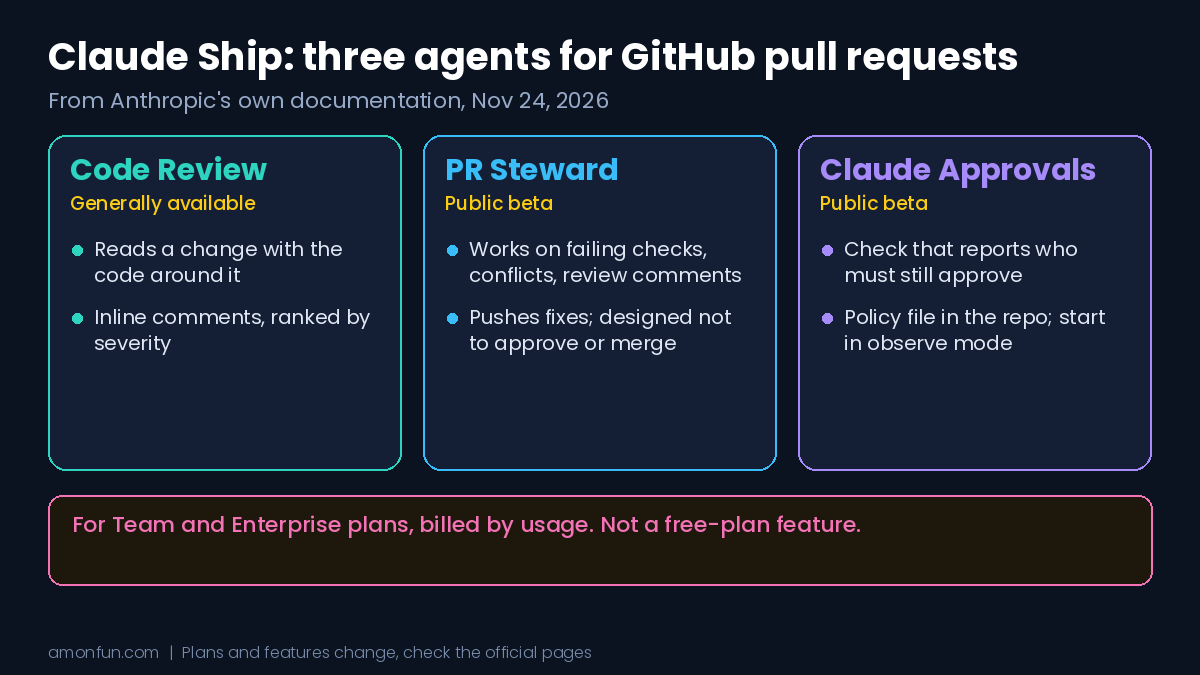
Anthropic launched Claude Ship on November 23, 2026. It is a set of AI agents that help get GitHub pull requests ready to merge. This guide explains each part in plain words and who can use it, using Anthropic's own documentation. We did not test it ourselves.
What is a pull request?
When a developer changes code on GitHub, the change is proposed as a pull request. Other people review it, fix problems and then approve it before it is merged into the main code. Claude Ship tries to help with the review, fix and approval steps.
The three agents
| Agent | What it does | Status |
|---|---|---|
| Code Review | Looks for logic errors, security problems and broken edge cases, with inline comments ranked by severity | Generally available |
| PR Steward | Works on failing checks, merge conflicts and review comments, and pushes commits with its fixes | Public beta |
| Claude Approvals | A check that reports who still has to approve, based on a policy file in your repository | Public beta |
Does Claude approve code on its own?
Only where you allow it. Anthropic says PR Steward is designed not to approve or merge pull requests. Claude Approvals follows a policy file that you write. The policy can say how many people must approve changes to a path, and where Claude may post an approving review. For example, billing code can require two people, while test fixtures can need one person once Code Review passes.
Merging is still decided by your settings and your GitHub branch rules. The Claude Approvals check only blocks a merge where you make it a required check in GitHub.
Who can use it?
Claude Ship is for organizations on Claude Team and Enterprise plans, and it works with repositories on GitHub. It is not a free-plan feature. Anthropic says it is not available to organizations with Zero Data Retention, the HIPAA configuration or customer-managed encryption keys, and Claude Approvals has more limits.
Each agent is billed by token usage through the organization's usage credits, separately from the plan's included usage. Anthropic's documentation says eligible Enterprise organizations can claim promotional credits. We do not list prices here because we did not find a fixed price on the pages we read.
For one of your own pull requests, Anthropic's documentation also mentions a /ship command in Claude Code that reviews and fixes locally.
Safety points to read before turning it on
- It can miss problems. Anthropic says Claude Ship uses AI and may miss bugs, security vulnerabilities or other issues.
- A merge without human review is possible. If a policy asks for nobody else, the author can fill the seat. With GitHub auto-merge or a merge queue and a policy that does not require a person, a change can merge without anyone acting.
- Start small. Turn on one agent at a time in one repository. For Claude Approvals, start in observe mode, where the check only shows what the policy would decide. Observe mode is still billed.
- Watch costs. PR Steward has no spend limit of its own until you set one.
- Automatic reviews can stop. Adding an approvals policy file can stop automatic Code Reviews on files it covers, unless a rule names claude/code_review.
Who is it for?
It is meant for teams that produce many pull requests, for example because AI tools write a lot of code, and need help reviewing them. If you work alone or on a free plan, you cannot use it, but the idea is still useful: let AI review code, and keep people in charge of what gets merged.
Sources: Anthropic: Claude Ship, Anthropic: Claude Approvals, SiliconANGLE.